
Beyond Immersion: virtual reality and sustainability competency development
Written by John (Zheng) Wang, Ivana (Shige) Yao, Vasiliki Kioupi
John (Zheng) Wang and Ivana (Shige) Yao were supported to complete this research project with LITE Sustainability & Community Engagement Incubator seedcorn funding. Vasiliki Kioupi provided supervision for the project.
In Higher Education we increasingly aim not only to teach our students about sustainability, but also to develop the competencies needed to address complex sustainability challenges. This ambition aligns with the University of Leeds Framework for Environmental and Social Responsibility 2026–2030, which commits the University to enabling students and staff to understand their role in creating a sustainable future, apply their skills and knowledge to sustainability challenges, and contribute to positive local and global change (University of Leeds, 2026).
In practice, this calls for capabilities reflected in the Leeds Skills Matrix, including systems and anticipatory thinking, critical thinking, strategic practice, collaboration, and integrated problem-solving. Together, these capabilities enable learners to recognise connections between environmental, social and economic systems, consider the consequences of different actions, work across perspectives, and translate understanding into equitable action. However, many sustainability challenges are difficult to experience directly because they are geographically distant or involve processes that are not immediately visible. Marine sustainability is one example. For students at an inland university such as Leeds, direct access to marine ecosystems can be difficult, while field-based learning presents financial, logistical and accessibility constraints (Wiek et al., 2011).
Virtual Reality (VR) offers one way to address this experiential gap by allowing students to interact with simulated environments that would otherwise be difficult to access. Yet immersion does not necessarily lead to deeper sustainability learning. Our LITE Incubator for Sustainability and Community Engagement Seed Corn project therefore explored a broader question: what can VR and traditional teaching respectively contribute to sustainability competency development, and how might their strengths be combined (Makransky & Petersen, 2021; Chen & Liu, 2020)?
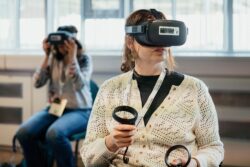
We worked with 11 postgraduate students, six of whom completed an immersive coral-restoration activity with VR technology, and five of whom took part in a conventional instructor-led session covering the same broad sustainability themes. Separate focus-group discussions were then used to explore how students understood and experienced the two approaches.
Our findings suggest that VR and traditional teaching supported different pathways into sustainability learning. VR provided students with a concrete and embodied starting point. Students frequently recalled procedural sequences and the underwater environment from their virtual experience. This helped transform an otherwise distant environmental issue into something more tangible and personally meaningful: “It used to be just an abstract concept to me, but now I feel more interested in it and care more about it” (VR Participant 4).
Traditional teaching supported a different form of learning. Students more readily discussed causal relationships and broader sustainability questions involving climate change, governance, responsibility, economic trade-offs and collective action. As one participant observed: “Sustainability is about finding a balance between economic development, environmental protection and social wellbeing. It concerns not only businesses and governments, but everyone in society” (Traditional Participant 1). Opportunities to ask questions, receive immediate explanations and exchange ideas during the class helped students connect individual concepts to wider sustainability systems. Another participant suggested that: “The opportunity to ask questions encouraged us to think independently before receiving answers and explanations, which helped us develop a deeper understanding of the impacts” (Traditional Participant 6).
Importantly, immersion was not simply a property of the technology. Students’ sense of involvement was also shaped by storytelling, prior experience, cultural familiarity and the quality of interaction.
Rather than showing that one approach was stronger overall, our findings suggest that the two supported different dimensions of sustainability thinking, with VR grounding learning in concrete experience and traditional teaching supporting broader conceptual and systemic understanding.
Meaningful sustainability learning may therefore benefit from bringing these strengths together: using experience to make complex issues tangible, and explanation and reflection to help students see the bigger picture and consider how their understanding can translate into action.
This shifts the educational question from whether VR is “better” than traditional teaching to how different learning approaches can be combined to support sustainability competencies. Many sustainability challenges involve complex systems, distant consequences or processes that students cannot easily experience first-hand, creating opportunities for experiential technologies to become part of a wider learning sequence. For example, students could experience a garment’s lifecycle or explore food-production systems before examining the environmental and social consequences of production and consumption. Similar approaches could make the SDGs more tangible by connecting low-carbon transport and urban resilience with sustainable cities (SDG 11), energy transitions with clean energy (SDG 7), responsible consumption with fashion, food and plastics (SDG 12), and marine pollution with life below water (SDG 14), while highlighting the cross-cutting importance of climate action (SDG 13).
Our study provides an initial step towards this, but the findings remain exploratory. The small-scale qualitative design limits the generalisability of the findings and does not allow us to establish whether the different patterns of sustainability thinking were caused by the teaching approaches themselves.
In addition, technical disruptions meant that not every student completed all VR activities, while its wider implementation requires equipment, dedicated space, technical support, and appropriate VR training for teaching staff, raising practical questions about scalability.
Future research could therefore explore how experience, explanation and reflection can be most effectively combined to support different sustainability competencies. Larger and more diverse studies could test this approach across different sustainability topics and examine whether these competencies develop beyond the immediate learning experience.


This is where collaboration across the University could take the project further. We welcome opportunities to work with colleagues teaching sustainability-related modules, as well as those involved in digital education and learning design, to adapt and evaluate this approach across themes such as sustainable food, fashion, transport, energy and the circular economy. These themes connect with the SDGs on zero hunger and health & wellbeing (SDGs 2 and 3), affordable and clean energy (SDG 7), sustainable cities and communities (SDG 11), responsible consumption and production (SDG 12), and climate action (SDG 13). Together, we could co-design immersive activities around existing course content and evaluate their educational value in authentic teaching contexts, particularly where important sustainability concepts are difficult to experience directly. Such collaboration would help establish where VR adds value and how immersive learning can support the University’s commitment to embedding sustainability in curricula and equipping students to contribute to the SDGs.
Interested in learning more about LITE's work in virtual and extended reality?
- Read this Fellowship case study about use of extended reality in geosciences education.
- Read this report of a spotLITE workshop which explored how to address barriers to using virtual reality in teaching.