
ALT OER26: Reflecting on Openness, Sustainability and Shared Responsibility
Written by Benjamin Chong
In June 2026, I attended ALT OER26 at The Open University in Milton Keynes, funded by the LITE Conference Fund. The conference, themed Openness Reimagined: Continuity, Change and Shared Vision, brought together educators, researchers, learning technologists and open education practitioners to explore the future of Open Educational Resources (OER) and open educational practice.
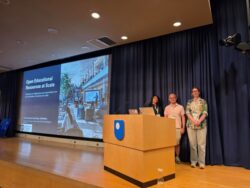
My primary reason for attending was to co-present a session entitled Open Educational Resources at Scale: Reflections on Infrastructure and Responsibility from the Universities of Coventry and Leeds alongside my colleague Kirstine McDermid from the University of Leeds and Dal Badesha from Coventry University.
While there are many colleagues across Leeds with extensive experience and expertise in OER, I volunteered to contribute an academic perspective to the presentation. In particular, I wanted to share my experiences of co-creating educational resources with students and alumni and to reflect on the value of openness for learners, educators and wider communities.
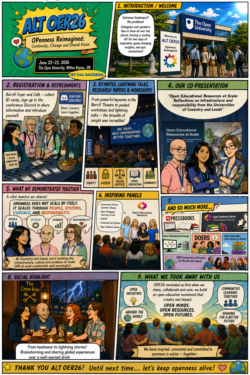
Travelling from Leeds to Milton Keynes is not particularly straightforward, and with conference funding available to support attendance for one day, I chose to attend on the day of our presentation. Although my time at the conference was brief, it was extremely valuable. I left with new ideas, new connections and renewed enthusiasm for the role of openness in higher education. The comic by Dal captures key moments from the conference, including keynote sessions, workshops, networking activities and our collaborative presentation on Open Educational Resources at Scale. Shared with permission from the creator.
Reflecting on our presentation
Our presentation explored how universities can support OER initiatives at scale through appropriate infrastructure, shared responsibility and collaborative cultures. Kirstine led the development of the presentation, creating the overall structure and discussion prompts, while Dal and I contributed insights from our respective institutional contexts.
For me, one of the most rewarding aspects of the presentation was the opportunity to discuss OER from the perspective of academic practice and co-creation. Much of my contribution focused on how educational resources can be developed in partnership with students, graduates and other stakeholders. Through this process, OER becomes more than a repository of learning materials. It becomes a mechanism through which learners contribute to the construction and dissemination of knowledge.
The presentation itself also provided an unexpected lesson in adaptability. Shortly before our session in the Berrill Lecture Theatre, the presentation failed to run properly on the host computer. Fortunately, because we had developed the slides collaboratively and asynchronously through shared online platforms, I was able to access the presentation immediately on my own laptop. I stepped in to support the delivery of the session and the presentation proceeded successfully. While initially stressful, the experience reinforced the value of collaborative working and digital resilience.
The discussions during and after the presentation also encouraged me to think about the future direction of my own OER work. To date, most of the OER projects I have contributed to have been those where I have been the lead author. However, I increasingly believe that sustainable open education requires broader participation from multiple stakeholders. My ambition is not simply to involve others in contributing content, but to engage students, alumni, educators, industry partners and professional communities in the ongoing development, production, curation and maintenance of OER.
In particular, I strongly support student-led approaches to OER development. When students become active contributors rather than passive consumers of knowledge, they gain valuable skills and develop a stronger sense of ownership over their learning. More importantly, today's learners may become tomorrow's educators, mentors and professional leaders within their own contexts. Through engaging with OER, they can become ambassadors for openness, taking knowledge into new communities and sharing it with future generations of learners.
Learning from the keynote: OER, sustainability and AI
The keynote session provided a thoughtful exploration of the relationship between OER, sustainability, artificial intelligence and Open, Distance and Digital Education (ODDE). A key message was that sustainable open education depends on far more than the creation of resources. It requires supportive institutional structures, quality assurance, technological infrastructure, communities of practice and a shared commitment to openness.
I was particularly interested in the framework that considered sustainability across macro, meso and micro levels. Sustainable OER depends on supportive policies and systems, institutional structures and cultures, and the actions of individual educators and learners. This resonated strongly with my own experiences of educational change, where lasting impact is rarely achieved through individual effort alone.
The keynote also highlighted the connection between OER and Sustainable Development Goal 4, which seeks to promote inclusive, equitable and lifelong learning opportunities for all. This prompted me to reflect on my own practice.
Much of what I do extends beyond formal module teaching. Whether through teaching on the Leeds International Summer School, supporting student societies with technical advice, mentoring students outside my own modules, or maintaining relationships with alumni and colleagues who seek guidance long after graduation, I see these interactions as part of a broader commitment to educational openness.
Artificial intelligence was another recurring theme throughout the keynote and conference discussions. There were understandable concerns that AI could potentially devalue OER or undermine the principles of openness. My own reflection is that AI should be viewed as a tool that complements rather than competes with OER. Just as AI is increasingly being integrated into authentic assessment, experiential learning and reflective practice, it can also support the creation, accessibility and dissemination of open educational resources. The challenge is ensuring that human values, expertise and communities remain at the centre of educational practice.
Exploring institutional barriers to open practice
Another insightful session I attended was the workshop Exploring Institutional Barriers to Open Practice: A Scottish Case Study led by Joe Wilson. The workshop explored how institutions can create the conditions necessary for open educational practices to flourish and how educators might motivate others to engage with openness.
Discussions focused on institutional support, leadership, policy, infrastructure and community-building. One statement that particularly resonated with me was that open education should be viewed not as the ‘back door’ but as the ‘front door’ to education. This idea aligns closely with my own belief that openness should be embedded within mainstream educational practice rather than treated as an optional add-on.
The workshop also gave me an opportunity to reflect on my decision to share resources openly through platforms such as Pressbooks and Zenodo. By making resources available beyond institutional boundaries, these platforms allow students, alumni, educators and industry partners to access and benefit from shared knowledge. However, the workshop reinforced my view that genuine openness extends far beyond publishing resources. It involves cultivating communities that sustain, improve and build upon those resources over time.
To sum up, ALT OER26 reminded me that openness is not simply about making educational resources freely available. It is about creating sustainable communities of learning, collaboration and shared responsibility. Knowledge does not stop with our students when they graduate. Instead, it continues to be shared, adapted and passed on from one learner to another. By involving students, alumni, educators and external partners in the creation and stewardship of OER, we can help ensure that openness remains a living, evolving and impactful part of higher education.
Author
Benjamin Chong
Associate Professor